
 INSTITUTE
More Than a Qualification
Young people need a supported bridge between study, real-world capability, employment, identity, purpose and future enterprise.
Study, work and enterprise pathways.
Create your career here.
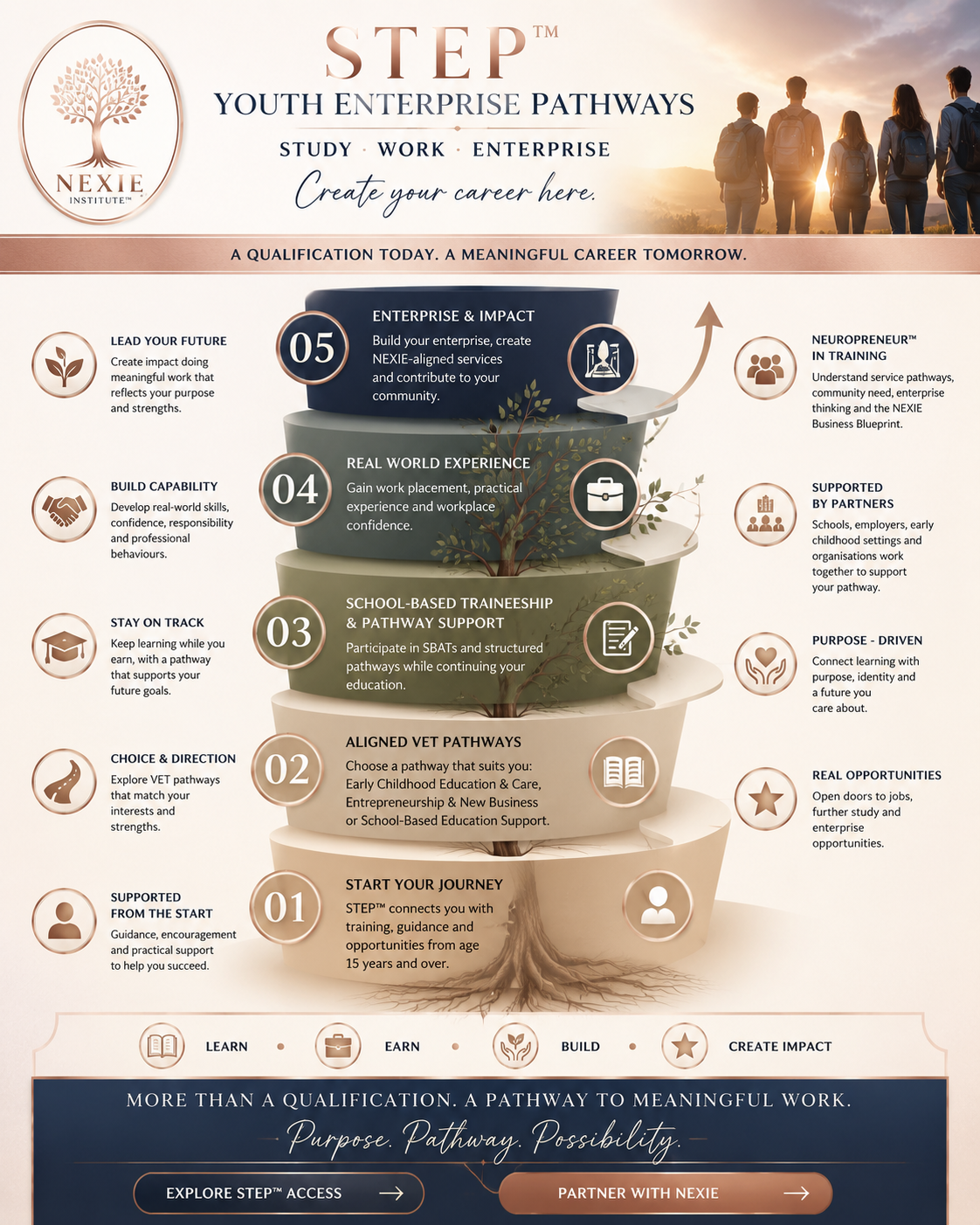
STEP connects young people aged 15 years and over with training, work placement, school-based traineeship and enterprise possibilities — so a qualification can become a practical pathway into meaningful work.
It is designed for students and early school leavers who need learning to feel real, useful and connected to purpose, capability, enterprise and future contribution.
Young people need a supported bridge between study, real-world capability, employment, identity, purpose and future enterprise.
Potential pathways include Early Childhood Education and Care, Entrepreneurship and New Business, and School-Based Education Support through registered training providers.
Schools, employers, early childhood settings and educational organisations can host work experience and school-based traineeship pathways.
Students can begin understanding service pathways, community need, enterprise thinking and the NEXIE Business Blueprint while building recognised skills.
Where a participant enters an approved SBAT or other lawful paid-employment pathway, learning may be connected with paid work. Other STEP models may involve vocational education, enterprise learning, mentoring or workplace exposure without paid employment. Participation requirements and remuneration are determined by the authorised organisations responsible for the selected pathway.
The goal is to help young people build purpose, skills, support, workplace exposure and a possible enterprise pathway. STEP does not guarantee qualification completion, an SBAT, work placement, employment, business income, customers or access to a NEXIE Productised Service.
Questions and Answers
STEP is being developed for eligible secondary students, early school leavers and young people who want learning to lead somewhere meaningful.
The pathway available to each participant will depend on their schooling status, learner eligibility, school and family involvement where required, RTO and employer arrangements, and the applicable education, training or employment requirements.
It may suit young people who are interested in VET, work placement, school-based traineeships, early childhood pathways, School Based Education Support, entrepreneurship or future Neuropreneur opportunities.
STEP is designed for different kinds of learners, including young people who may not feel connected to traditional academic pathways.
Some students are practical, creative, relational, entrepreneurial or built for real-world learning. STEP gives those students a pathway where learning can connect to work, purpose and enterprise.
Parents and carers can explore STEP if they are seeking practical pathway options for a young person.
This may include VET pathways, work placement, supported learning, early school-leaver options, enterprise exploration or future NEXIE-aligned business pathways.
NEXIE does not directly issue nationally recognised qualifications.
Aligned qualifications are delivered by registered training organisations where available. NEXIE provides the pathway design, NEXIE Business Blueprint, productised service model, developmental framework and enterprise direction.
Schools, RTOs, employers, early childhood services and education settings may partner with NEXIE to explore training, work placement, school-based traineeship and enterprise pathways.
Partnerships help young people connect learning with real environments, workplace expectations, service opportunities and community contribution.
STEP can become an early pathway into the Neuropreneur journey.
Students may begin by exploring purpose, enterprise thinking, community need, service pathways and the NEXIE Business Blueprint while building recognised skills and workplace experience.
Purpose. Pathway. Possibility.